
The global economy is entering a decisive era of change. Digital transformation is no longer a future concept, it is actively reshaping careers, industries, and the skills required to succeed. For professionals today, understanding economics in a digital context is essential for long-term career growth and relevance.
Technological innovation is influencing how markets function, how value is created, and how decisions are made. According to the World Economic Forum, 23% of all jobs are expected to be changed by technology and automation by 2027. This transformation is not limited to automation alone; it also includes the growing role of data, digital platforms, and analytical tools in economic systems.
For professionals in Zambia and across the region, the implications are clear: adapting to digital change is no longer optional, it is a necessity.
The Growing Need for Reskilling
As technology becomes embedded in everyday work, many traditional skills are quickly becoming outdated. Research shows that 50% of all employees will need reskilling by 2025 due to the rapid adoption of digital technologies across industries.
This shift highlights the importance of choosing qualifications that combine strong analytical thinking with practical, future-ready skills. Degrees that integrate economics with digital tools and data analysis are increasingly valuable in today’s labour market.
This is where the Master of Science in Economics at CBU eCampus offers a strong pathway for career development. The programme equips professionals with the knowledge and skills required to navigate modern economic challenges.
The Versatility of Economics in a Digital Economy
One of the strongest advantages of economics is its flexibility. Unlike narrow technical fields, economics provides transferable skills that remain relevant across industries and over time.
According to the Reserve Bank of Australia, economics is among the most versatile fields of study, with graduates working across sectors such as finance, government, technology, healthcare, development organizations, and international institutions.
In the digital era, the role of the economist has expanded significantly. Economists are no longer confined to theoretical analysis. The Bureau of Labor Statistics confirms that economists contribute directly to policy decisions, economic forecasting, and strategic business planning, making them central to both public and private sector decision-making.
As economies become more data-driven, the demand for professionals who can interpret complex economic information continues to grow.
Why Study Economics at CBU eCampus?
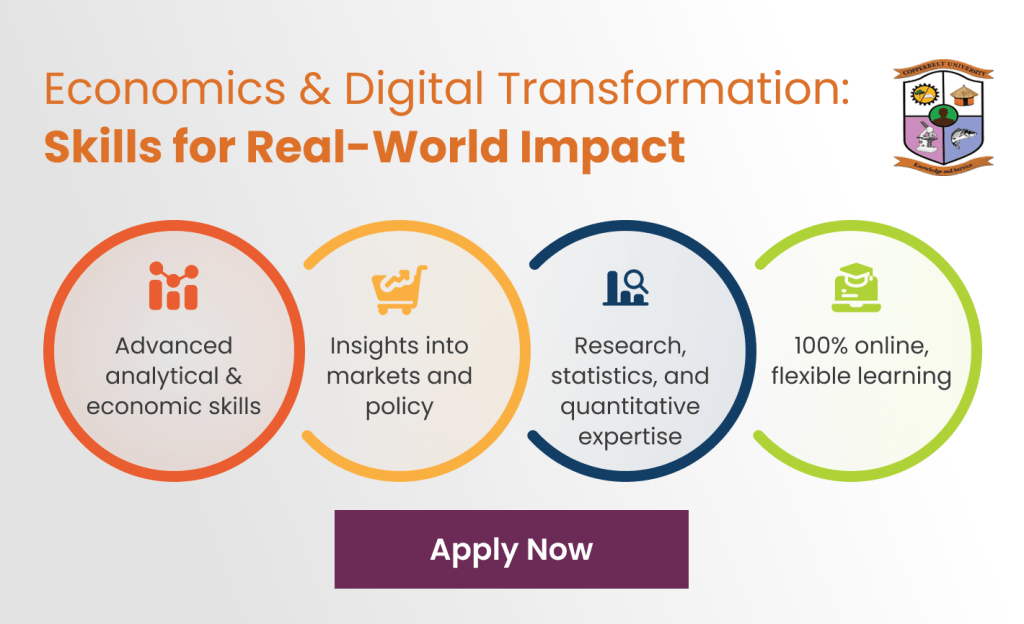
The Master of Science in Economics at CBU eCampus is designed specifically for working professionals who want to strengthen their economic expertise while maintaining flexibility. The programme combines academic depth with real-world relevance.
1. A Modern, Career-Focused Curriculum
The curriculum goes beyond traditional theory and focuses on practical application. Key areas include:
- Advanced Econometrics (GEC 640 & 730): Training in data analysis using tools such as STATA, E-Views, and R.
- Mathematical Economics (GEC 630): Development of modelling and optimization skills used in modern economic analysis.
- Specialisation Streams: Students can choose from four focused pathways:
- Development Economics
- International Economics
- Monetary Economics
- Health Economics
These options allow students to align their studies with specific career goals.
2. Fully Online Learning for Working Professionals
CBU eCampus delivers the programme entirely online through a modern Learning Management System developed in partnership with Astria Learning. This digital infrastructure allows students to:
- Study from anywhere
- Learn at their own pace
- Balance education with professional and personal commitments
You can explore the key features and benefits of studying online at CBU eCampus here.
3. Expert Faculty and Academic Excellence
CBU eCampus brings together experienced academics and professionals with strong backgrounds in policy, research, and applied economics. This ensures that students gain knowledge that is both theoretically sound and directly applicable to real-world economic challenges.
Preparing for Leadership in a Digital Economy
The MSc in Economics at CBU eCampus is designed to develop professionals who can adapt, lead, and make informed decisions in a rapidly changing economic environment. Graduates gain the ability to analyze market trends, interpret economic data, and support sustainable development initiatives.
To understand how these skills align with future career demands, explore CBU eCampus’s guide on future-proofing your career and mastering key skills for 2026.