

What is a Master of Arts in Peace and Conflict?
Peace and conflict studies is a field that focuses on understanding the causes of conflict, exploring ways to prevent violence, and finding solutions that lead to lasting peace. It combines insights from law, psychology, politics, sociology, and history, while also teaching practical skills like negotiation, mediation, and dialogue facilitation. Students gain the ability to analyze complex problems, resolve disputes, and build stronger, more cooperative communities at both local and global levels. The knowledge and skills from this field are applied in diplomacy, humanitarian work, education, law, and many other careers.
For those ready to take the next step, the Masters of Arts in Peace and Conflict at CBU ECAMPUS offers a 100% online program that equips students with the tools to create real change in today’s world.
Peace and conflict studies programs are designed to explore and answer key questions such as:
- What are the root causes of conflict?
- How do we define violence, and what impact does it have on individuals and societies?
- What approaches can effectively resolve conflict?
- What is peace, and how can it be restored after conflict?
- Which practices help to promote and sustain peace?
- Is peace a fundamental human right, and if so, how can it be protected?
- Is lasting peace truly achievable?
Graduates of peace and conflict studies gain the knowledge and skills to apply these insights across a wide range of career paths.
Why Peace and Conflict Studies Matter Today
At first, the questions raised in peace and conflict studies might seem philosophical or even a bit abstract. But if you’re a student who wants to make a real difference in the world, you’ll quickly see that this field is not just theory, it’s about practical ways to reduce conflict, build understanding, and create lasting peace.
Conflict is not a new phenomenon. Since the earliest times, people have fought in organized groups. Although the scale and methods of conflict have changed, the need to understand and prevent violence has always been important. Peace and conflict studies first emerged formally as an academic discipline after World War II, but in reality, people have been searching for ways to foster peace for centuries. In today’s world, conflict is everywhere, from wars and political crises to workplace disagreements and family disputes. While peace sometimes feels far away, there are professionals working every day to build bridges, solve problems, and create better futures. This is where the Masters of Arts in Peace and Conflict comes in. It gives students the tools to understand why conflicts happen, how they affect people, and most importantly, how to resolve them.
With wars, migration, human rights issues, and global inequality shaping our future, the demand for skilled peacebuilders is higher than ever. Graduates with peace and conflict studies degrees are employed across a wide variety of sectors, from nonprofit organizations and government agencies to global corporations and humanitarian groups. They take on roles such as human rights officers, program managers, analysts, legal officers, victim mediators, journalists, and even executives in NGOs.
Advantages of Studying Peace and Conflict
One of the biggest strengths of the Masters of Arts in Peace and Conflict is that it is interdisciplinary. It combines knowledge from law, psychology, history, political science, sociology, and cultural studies. This mix gives students both broad knowledge and very practical skills.
Here are some key benefits:
- Critical thinking – learning to see complex problems from multiple perspectives.
- Conflict resolution – mastering mediation, negotiation, and dialogue techniques.
- Communication skills – being able to work across cultures and communities.
- Transferable applications – lessons apply globally, but also in everyday workplaces and schools.
Most importantly, this degree goes beyond the screen and applies to real-world situations. The Masters of Arts in Peace and Conflict prepares graduates to take theory and put it into practice, whether they are working in humanitarian organizations, government, education, or business.
Careers You Can Pursue with a Degree in Peace and Conflict Studies
Graduates of Peace and Conflict Studies are well-prepared for diverse and impactful career paths. With expertise in conflict analysis, negotiation, mediation, and policy-making, they contribute to peacebuilding, social justice, and sustainable development at local, national, and international levels. Below are some of the most promising career options:
-
Mediator
Facilitates constructive dialogue and negotiation between conflicting parties, helping people understand different perspectives, identify shared interests, and work toward mutually acceptable solutions—whether in workplaces, communities, or international disputes. Mediators typically earn $40,000–$80,000 annually. -
Conflict Resolution Specialist
Analyzes the root causes of conflicts and develops strategies to promote peaceful outcomes. Working in governments, NGOs, corporations, or as consultants, they ensure conflicts are addressed constructively and sustainably. Salaries usually range from $50,000 to $80,000 per year. -
Humanitarian Aid Worker
Provides emergency relief and long-term recovery assistance in conflict zones, disaster-affected areas, and humanitarian crises. This role is vital for helping communities rebuild resilience and stability, with annual earnings that can vary widely from $30,000 to $150,000 depending on experience and location. -
Diplomat
Represents a nation’s interests abroad, engages in negotiations, and fosters peaceful international relations. Diplomats play a key role in dialogue, peace treaties, and global conflict resolution, typically earning between $40,000 and $250,000 per year. -
Policy Analyst
Researches, evaluates, and develops policies on conflict prevention, peacebuilding, and international relations. By providing evidence-based recommendations, they shape decision-making at national and global levels. Salaries for policy analysts generally fall between $45,000 and $150,000 annually. -
Community Outreach Coordinator
Works at the grassroots level to build understanding and reconciliation within diverse communities. Coordinators lead initiatives that promote collaboration, conflict resolution skills, and long-term peacebuilding, usually earning $35,000–$90,000 per year. -
International Development Consultant
Advises governments, NGOs, and international bodies on projects in post-conflict or developing regions. These consultants help design and implement programs addressing socio-economic challenges and advancing the UN Sustainable Development Goals (SDGs). Annual salaries typically range from $60,000 to $150,000. -
Human Rights Advocate
Promotes justice, accountability, and reconciliation for victims of human rights abuses. Advocates may work with truth commissions, legal institutions, or NGOs to ensure protection and recognition of rights. Salaries usually range from $30,000 to $100,000 annually. -
Resettlement Officer
Supports refugees and displaced individuals as they resettle and integrate into new communities. Officers coordinate services, provide guidance, and ensure vulnerable groups receive essential assistance. This role generally pays between $30,000 and $100,000 per year. -
Public Relations Officer
Shapes and manages an organization’s public image, especially during crises. PROs build trust, strengthen communication strategies, and promote messages of peace, inclusivity, and social responsibility. Salaries typically range from $45,000 to $100,000 annually.
If you’re already working in this field or in a related area, don’t worry. With 100% online degrees at CBU, we make sure your studies fit your schedule. You can also find helpful tips on balancing work and study here.
Is the CBU Master of Arts in Peace and Conflict Right for You?
For those who want to take the next step, the CBU ECAMPUS offers a 100% online Master of Arts in Peace and Conflict. This program blends theory with practical training in mediation, dialogue facilitation, and peacebuilding strategies.
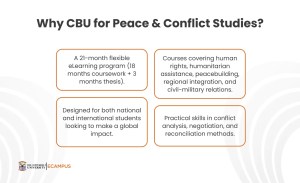
Highlights include:
- A 21-month flexible eLearning program (18 months coursework + 3 months thesis).
- Courses covering human rights, humanitarian assistance, peacebuilding, regional integration, and civil-military relations.
- Practical skills in conflict analysis, negotiation, and reconciliation methods.
- Designed for both national and international students looking to make a global impact.
This online program offers you the flexibility to study from anywhere, while equipping you with the advanced skills necessary to lead in diplomacy, humanitarian work, or social development. If you’d like to learn why online degrees are one of the best choices for your career, check out this blog.
Conclusion: Building a Career That Matters
Out of the last 3,400 years, historians say only about 268 have been truly peaceful. While lasting global peace may be hard to achieve, the role of peacebuilders is to reduce violence, heal communities, and create fairer societies.
By studying the Master of Arts in Peace and Conflict, you’re not only building a career, you’re choosing a path that makes a difference. Whether you work in diplomacy, education, nonprofits, or mediation, your skills will help create more understanding and cooperation in a divided world.
If you’re ready to transform your future and contribute to lasting change, the Master of Arts in Peace and Conflict from CBU could be the perfect next step.